Press enter or spacebar to select a desired language.

APA (American Psychological Association)-English

Introduction

The Publication Manual of the APA is a specialized guide that helps students master academic writing, develop critical and analytical thinking, and improve the precision and clarity of their communication. The manual supports and strengthens your writing by showing the research you have conducted, helping you avoid plagiarism, and ensuring that others can access the sources you cite.

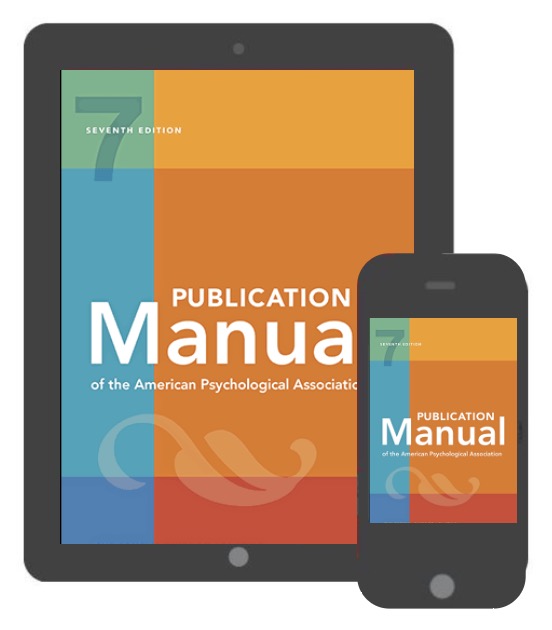
You can find the Publication Manual of the American Psychological Association (7th edition) at the Library.

General elements for writing in APA format

 • Font options: Calibri 11, Arial 11, Lucida Sans Unicode 10, Times New Roman 12, Georgia 11

 • Paragraphs must be double-spaced

 • Use 1-inch margins on all four sides of the page

 • Align paragraphs to the left

 • Indent the first line of each paragraph by 0.5 inches

Grammar

  • Communication should be clear, organized, and concise.
  • Develop a writing style that presents key points in an engaging way, captures the reader’s attention, and makes your ideas more effective.
  • This will contribute to a meaningful and impactful paper.

In academic writing, you should avoid...

  • Wordiness – using more words than necessary.
     Example:
     Instead of: Due to the fact that...
     Use: Because...
  • Redundancy – using multiple words that mean the same thing.
     Example:
     Instead of: A free gift
     Use: A gift
  • Tone – avoid literary or overly poetic language.
  • Sentence and paragraph length – keep sentences and paragraphs clear and concise; avoid overly long or run-on constructions.
  • Colloquialisms – informal expressions used in everyday speech.
     Example:
     Instead of: My friends and I went to NYC for fun.
     Use: My colleagues and I attended the Language Conference at New York University.

Slang – informal or non-standard language.

 Example:

 Instead of: He bailed on the meeting.

 Use: He did not attend the meeting.

It is important that when writing your text…

When writing academic papers, it is important to use language that is inclusive and respectful of all individuals and groups. To achieve this, students are encouraged to:

  • Use language that acknowledges and affirms diversity.
     
  • Avoid reinforcing stereotypes, harmful beliefs, or demeaning attitudes.
     
  • Review writing carefully to identify and eliminate potential bias.
     
  • Follow the APA guidelines for bias-free language when referring to people, with attention to areas such as age, disability, gender, research participation, racial and ethnic identity, sexual orientation, socioeconomic status, and intersectionality.

Principles of Bias-Free Language

Be specific:

When referring to people, use precise, respectful terms that avoid discriminatory connotations.

 Example:

  • Instead of using man to refer to humankind, use individuals, people, or persons.

Focus on relevant characteristics:
Describe only characteristics that are relevant to the context. While it is possible to refer to a person’s age, disability, gender identity, research participation, racial and ethnic identity, sexual orientation, socioeconomic status, or other attributes in a bias-free way, it is not always necessary to include all of this information in your writing.

Acknowledge people’s humanity:

  • Show respect for individuals’ personhood and humanity.
     
  • Avoid using adjectives as nouns (e.g., the gays, the poor, the elderly) or labeling people by a medical condition (e.g., schizophrenics, amnesiacs).
     
  • When referring to a disability or medical condition, use person-first language.

Example:

Say “a person with paraplegia” instead of “a paraplegic.”

Be sensitive with labels:

  • Respect how individuals describe themselves.
     
  • Use terms that are non-stigmatizing and affirming.


Examples:

Use “a transgender person” instead of “a transgendered” or “a transsexual.”

Use “people with substance use disorder” instead of “addicts” or “drug abusers.”

Use “person with a mental health condition” instead of “the mentally ill.”

Tables and figures are important because they:

  • Summarize information.
     
  • Present data, results, and statistics.

Do not include tables or figures solely to make your paper more visually appealing. Use them only when they are necessary to support or clarify your writing.

APA Citation:

In APA Style (7th edition), both tables and figures must be clearly numbered and titled. Each should include:

  • The table or figure number (e.g., Table 1, Figure 1) appears above the table or figure title and body in bold font. Number tables and figures in the order in which they are mentioned in your paper.
  • Title appears one double-spaced line below the table or figure number. Capitalize the table or figure title in italic title case.
  • A note below the table or figure explaining any abbreviations, symbols, or statistical notations used.
  • A source citation below the note if the content is adapted or reproduced from another work (with appropriate attribution).

In the body of your text, refer to each table or figure by its number (e.g., “see Table 2” or “as shown in Figure 1”) and discuss its relevance to your findings.

Basic table components

Table example:

Why is it important to cite your sources?

  • It supports and strengthens your writing by showing the research behind your ideas.
     
  • It helps you avoid plagiarism.
     
  • It allows others to access the sources you used.
     
  • It improves your academic writing skills.
     
  • It contributes to producing a clear, consistent, and high-quality paper.
     
  • It adds credibility to your work.
     

It reinforces, supports, and defends your arguments.

Direct citation

  • Reproduces the exact words of the author (“copy/paste”).
     
  • Use direct citations when it is essential not to alter the original meaning, when the idea cannot be paraphrased accurately, or when you want to preserve the author's exact wording.
     
  • A direct citation must always include the following elements:
     
    • Author’s last name(s)
       
    • Year of publication
       
    • Page number (or paragraph number, if pages are not available)
       

Use quotation marks and include the page number (or paragraph number if no pages are available).

Example (narrative citation):
According to Smith (2020), “critical thinking is the foundation of academic success” (p. 45).

Example (parenthetical citation):

“Critical thinking is the foundation of academic success” (Smith, 2020, p. 45).

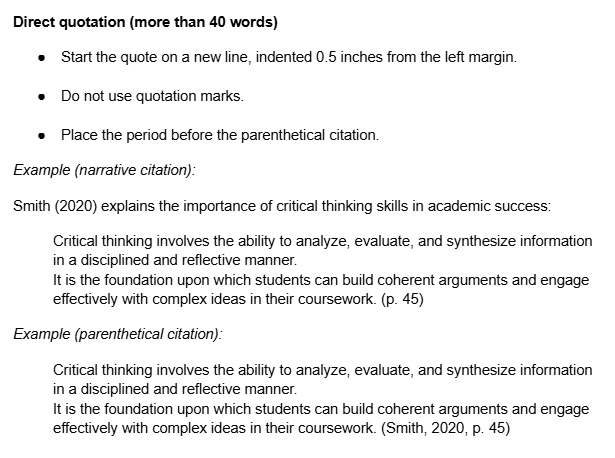
Direct quotation (more than 40 words)

Indirect citation (Paraphrasing)

  • Express the author’s idea in your own words.
     
  • Summarizes or comments on the author's words without changing the original meaning.
     
  • Involves interpretation or analysis of the original idea.
     
  • An indirect citation must always include the following elements:
     
    • Author’s last name(s)
       
    • Year of publication
       

Example (narrative citation):

According to Smith (2020), critical thinking encompasses a range of cognitive skills, including analyzing, evaluating, and synthesizing information. These skills are essential for students to construct well-founded arguments and to engage deeply with academic content.

Example (parenthetical citation):

Critical thinking includes various cognitive processes such as analysis, evaluation, and synthesis, which are necessary for creating strong academic arguments and engaging thoroughly with course material (Smith, 2020).

Citing a secondary source

Sometimes, you may want to reference information or a quotation that you found in a source but that originally comes from another author. This is called citing a secondary source.

  • Whenever possible, try to locate and cite the original source directly.
     
  • If that is not possible, cite the secondary source you have accessed.
     
  • In the text, name the original author and year, then write “as cited in” followed by the secondary source’s author and year.
     
  • In the reference list, include only the secondary source you actually read.

Example (narrative citation):

Freud’s theory of psychoanalysis (as cited in Smith, 2020) remains influential in psychology today.

Example (parenthetical citation):

Psychoanalysis continues to be influential in psychology (Freud, as cited in Smith, 2020).

Personal Communication Citation (by phone, email, or in person)

Personal communications are not retrievable by others but must be attributed to the source in the following format. They are not included in the reference list.

(I. Last Name, personal communication, Month Day, Year)

Examples

In-person conversation:

(L. Johnson, personal communication, February 18, 2025)

Email:

(I. García, personal communication, March 10, 2023)

Elements of a Reference List:

  • Allows others to locate the sources you cited in your text.
  • Includes information such as author, publication year, title, and source.
  • Appears at the end of the document.
  • Double-spaced throughout.
  • The second and subsequent lines of each entry are indented 0.5 inches (hanging indent).
  • Entries are organized alphabetically.
  • Two or more works by the same author are arranged by date, starting with the earliest.
  • Do not number or bullet the entries.
  • Only sources cited in the text should be included in the reference list.
  • Works without an author:
    • If authored by an organization or entity, use the organization's name as the author.
    • If marked as anonymous, use the word “Anonymous” in the author position.
    • If no author information is available, move the title to the author position.