Press enter or spacebar to select a desired language.

MLA (Modern Language Association)-English

Introduction

The Modern Language Association (MLA) Style Manual is a set of standards for writing and documentation used by writers and students to locate and evaluate information sources.

Its purpose is to foster confidence in the information we share and to guide the expression of ideas in our communication with others.

Modern Language Association (MLA) Style Manual, 9th ed.

imagen manual estilo MLA

General elements for preparing the written work

  • Use 8.5" × 11" paper.
  • Double-space the text.
  • Use a legible font (e.g., Times New Roman) between 11 and 13 pt, unless your instructor specifies a different size.
  • Set 1" margins on all sides.
  • Align the text to the left margin.
  • Indent the first line of each paragraph ½ inch.
  • Do not include a title page unless instructed otherwise.

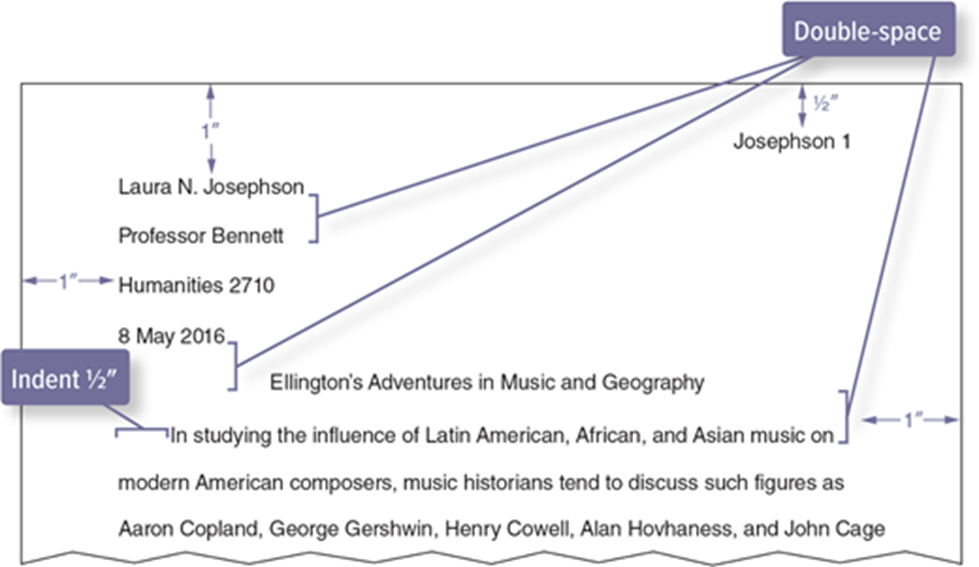
First page of an MLA-style paper

first page mla

  • In the upper left-hand corner, write your full name, your instructor’s name, the course, and the date.
     
  • In the upper right-hand corner, start page numbering by writing your last name followed by the page number, placed ½ inch from the top margin.
     
  • Do NOT italicize, bold, underline, or write the title in all capital letters.
     
  • Only italicize words that would normally appear in italics within the body of the text.
     *Example: Concepts of Justice in To Kill a Mockingbird
     
  • Use capitalization rules appropriate to the language of the text.
     English: America Watches Television; What is Literature?
     Spanish: Cortejo a lo prohibido: Lectoras y escritoras en la España moderna
     
  • Indent the first line of each paragraph ½ inch from the left margin.

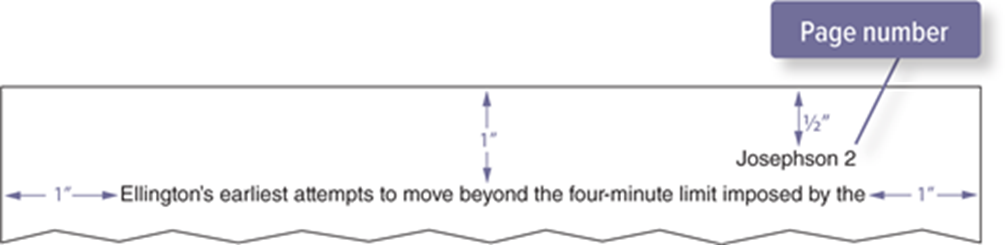
Header and Page Numbering

Header MLA

  • Number the pages in the upper right-hand corner, ½ inch from the top margin.
     
  • Write your last name, followed by a space and then the page number.
     
  • If the paper has multiple authors, you may choose to include only the page number.

What is plagiarism?

According to the Royal Spanish Academy, plagiarism is “copying substantially from others’ works and presenting them as one’s own.” Plagiarism occurs when a work is disclosed, published, or reproduced under someone’s name other than the original author.

Plagiarism has two main characteristics:

  • Unauthorized total or partial copying of another person’s work.
     
  • Presenting someone else’s work as your own, thereby replacing the original author.

Self-plagiarism

 Self-plagiarism can occur in various situations, such as:

  • Submitting the same paper in multiple courses under different titles.
     
  • Reusing parts of a previous paper in a new one without citing yourself.

Forms of plagiarism

  • Copying someone else’s work without giving credit.
     
  • Paraphrasing someone else’s ideas, arguments, or unique phrasing without credit.
     
  • Submitting a paper written by someone else, even if it was paid for.
     
  • Plagiarizing your own previous work.

How to avoid plagiarism

  • Give credit by quoting the author’s exact words and providing a bibliographic reference
     
  • Paraphrase the author’s original ideas and words, while crediting them through citation and bibliographic reference
     

Use a recognized style guide for citation and references, such as the Modern Language Association (MLA) Style Manual

Academic Plagiarism

At Universidad del Sagrado Corazón, academic dishonesty will not be tolerated, as stated in its Academic Integrity Policy.

All instances of academic dishonesty will be addressed according to the Academic Integrity Procedure.

General Information

All information presented in the paper must appear in the Works Cited list. The details included in citations may vary depending on the type of source. Your paper or research should consist mainly of your own words and ideas. Quotations should be used only to explain and support the content of your writing.

One Author

In-text citation:

John Steinbeck describes the struggle of migrant families as “a journey that left behind hope and picked up survival” (82).

Parenthetical citation:

The journey of the migrant families is described as “a journey that left behind hope and picked up survival” (Steinbeck 82).

Works Cited:

Steinbeck, John. The Grapes of Wrath. Penguin Books, 2006.

Two Authors

In-text citation: Include first and last names the first time the authors are mentioned in prose. For subsequent mentions, use only the last names.

Emily Johnson and Marcus Lee argue that social media “has altered the landscape of interpersonal communication” (45).

Johnson and Lee further claim that this change “requires new literacy skills” (46).

Parenthetical citation: Include both last names at the end of the sentence.

(Smith and Taylor 112).

Works Cited:

Smith, Rebecca, and Jason Taylor. Digital Dialogue: Communication in the 21st Century. Oxford UP, 2020.

Three or more authors

In-text citation: You may list all names or write the first author's name followed by “and others” or “and colleagues.”

Maria Chen and colleagues state that “early childhood education significantly impacts cognitive development” (58).
 OR
Maria Chen, David Grant, and Lisa Kim state that “early childhood education significantly impacts cognitive development” (58).

Parenthetical citation: Write the first author's last name followed by et al. and the page number.

(Chen et al. 58).

Works Cited:

Chen, Maria, David Grant, and Lisa Kim. Foundations of Early Learning. Harvard Education Press, 2018.

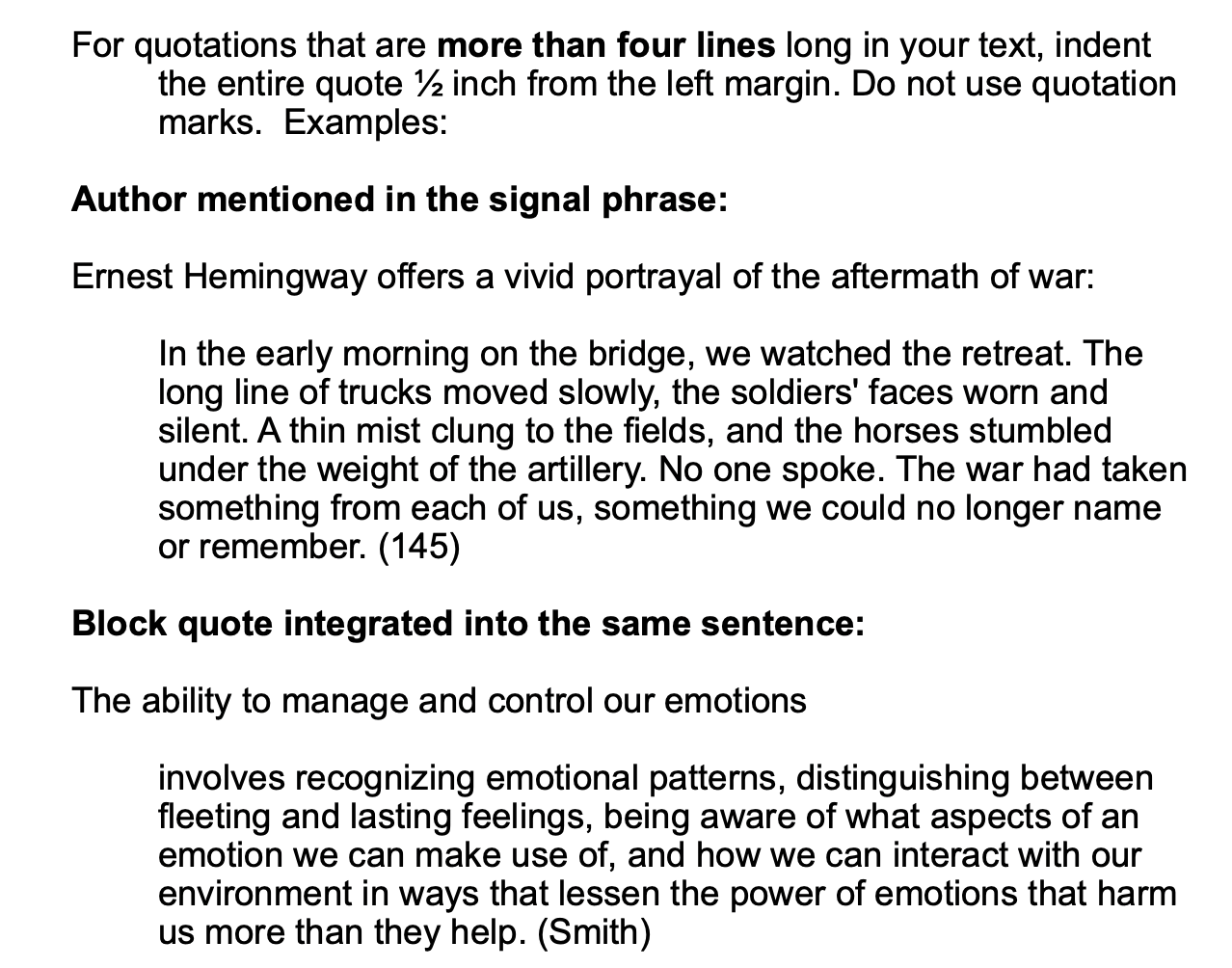
Long Quotations (Block Quotes)

long quotaion mla

Indirect Citation

In this type of citation, you express the author’s idea in your own words.

In-text examples:

One author:

According to Michael Pollan, it's increasingly evident that our relationship with food reflects a broader cultural and ecological disconnect (112).

Two authors:

Others, like Katherine Hayhoe and Edward Maibach, argue that scientists still struggle to effectively communicate the human health risks posed by climate change (3–4).

Three or more authors:

Paul Slovic and his colleagues claim that the perceived truth of statements plays a critical role in how persuasive an argument is (58).

Parenthetical citation examples: 

There are clear indications of a conflict of interest in this case (Pollan 112).

Some researchers argue that scientists still struggle to communicate the human health risks of climate change (Hayhoe and Maibach 3–4).

The authors argue that the perceived truth of a statement influences how persuasive it is (Slovic et al. 58).

Secondary Sources

When including a quote from an author who is quoted within another source, use “qtd. in” (quoted in), followed by the author and page number if available.

Example:

Angela Davis states that “radical simply means ‘grasping things at the root’” (qtd. in Taylor 27).

Works Cited:

Taylor, Keeanga-Yamahtta. How We Get Free: Black Feminism and the Combahee River Collective. Haymarket Books, 2017.

Audio or Video Citations

The title should be placed in italics and include the hours, minutes, and seconds (hh:mm:ss) as shown in the media player.

Example:

With quiet intensity, the character says, “I'm still standing. I'm still strong. And I always will be” (Antwone Fisher 01:35:12–17).

Works Cited:

Antwone Fisher. Directed by Denzel Washington, performances by Derek Luke and Denzel Washington, Fox Searchlight Pictures, 2002. Hulu app.

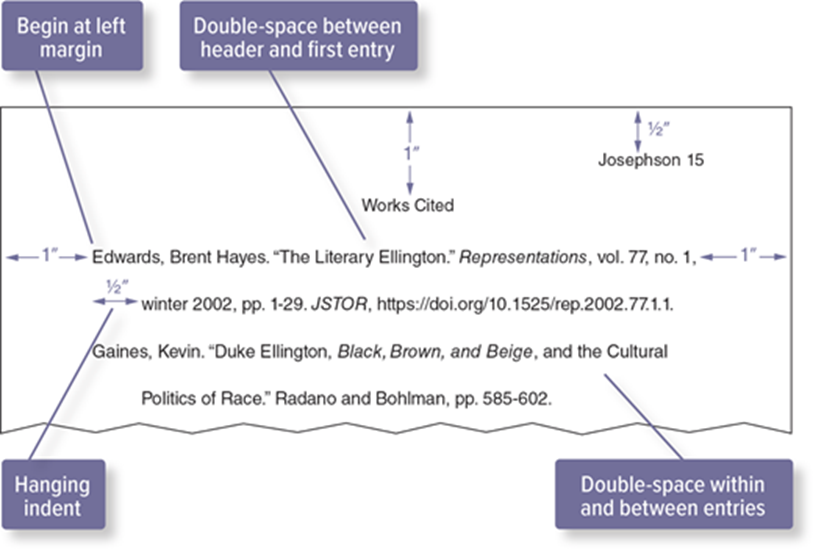
How to create the Works Cited list?

  • Every source cited in your text must appear in the Works Cited list.
     
  • On a separate page at the end of your paper, write the title Works Cited centered at the top of the page.
     
  • If you wish to include resources consulted but not cited, use the title Works Cited and Consulted.
     
  • The title should not be italicized, bolded, or placed in quotation marks.
     
  • Entries should be aligned to the left margin and double-spaced.
     
  • Use a hanging indent of ½ inch for lines after the first in each entry.

Arrange entries alphabetically by the author’s last name.
 

obras citadas


General Elements

MLA recommends including the following elements in each citation (when available), in this order and with the punctuation shown:

  • Author.
     
  • Title of source.
     
  • Title of container,
     
  • Contributor,
     
  • Version/Edition,
     
  • Number,
     
  • Publisher,
     
  • Date of publication,
     
  • Location.

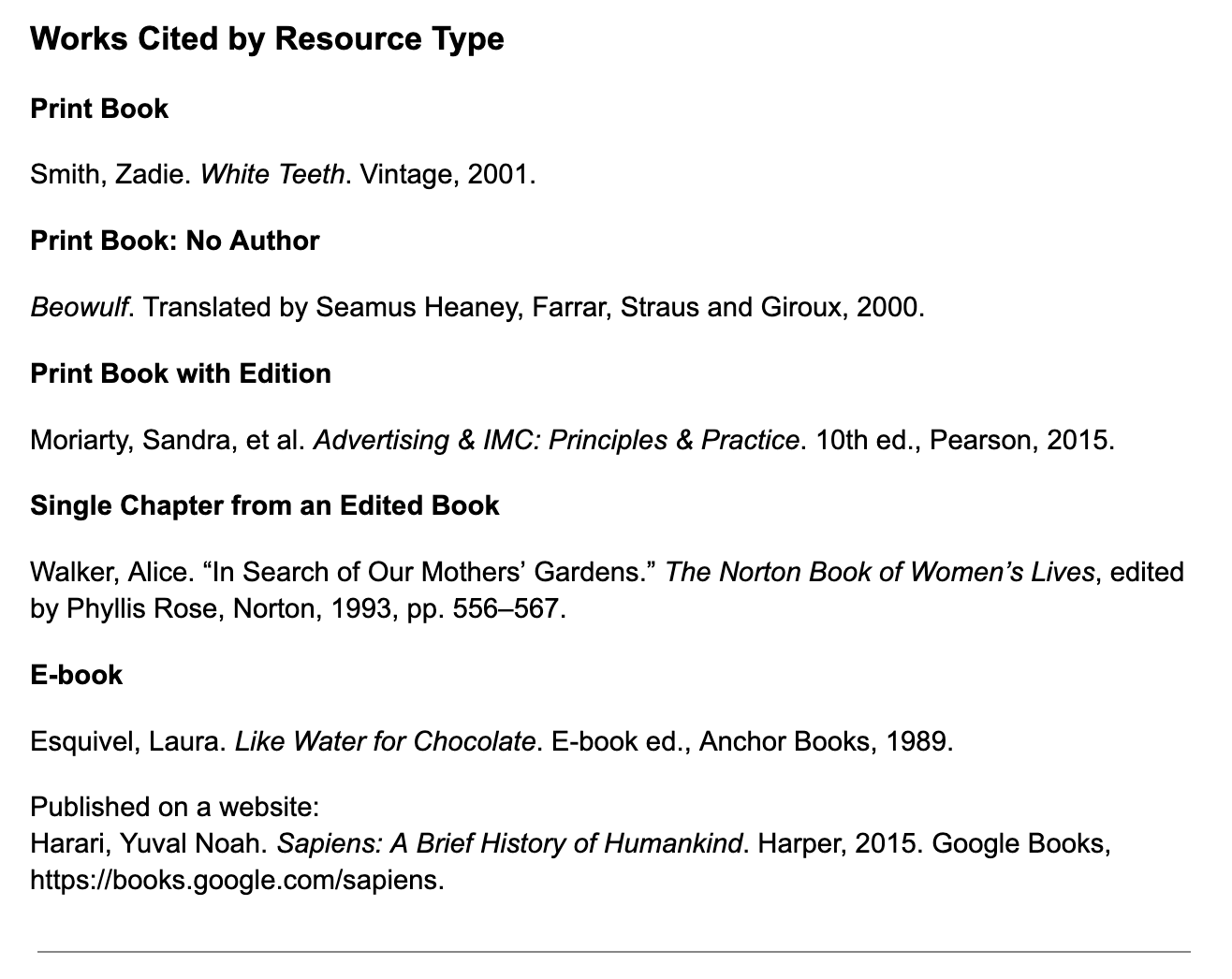
Works Cited by Resource Type

works cited list by type

Document

portada manual MLA